Applying Samatha–Vipassanā to Contemplation of Feelings
Updated: Aug 15
A Practical Introduction to Vedanānupassanā: Finding Peace Through Contemplation
Editor’s Note
This article is adapted from a teaching by Venerable Dianwu titled *Applying Calm and Insight (止观的运用). The original spoken teaching has been edited and reorganized for clarity, readability, and use on the Agama Meditation Centre website. Repetitions and oral transitions have been streamlined while preserving the main structure, terminology, and practical intent of the teaching
In Buddhist meditation, feelings are not treated as personal possessions or emotional stories. They are observed as direct experiences arising in the body and mind. This practice is known in Pāli as vedanānupassanā, or contemplation of feelings.
The word vedanā means feeling or felt experience. In this context, it does not mainly refer to emotion. It refers to the basic tone of experience: pleasant, unpleasant, or neutral.
This article focuses on how the method of samatha-vipassanā can be applied to the contemplation of feelings. A common example is physical pain during sitting or standing meditation: pain in the knees, pressure in the feet, tightness in the waist, discomfort in the shoulders, heat, numbness, itching, or other unpleasant sensations.
At first, these experiences may seem like obstacles. They make practice difficult. The body feels uncomfortable, and the mind often reacts with resistance, irritation, fear, or the wish to escape.
But when the method is understood, unpleasant feelings are no longer only obstacles. They become objects of practice. They become places where calm, mindfulness, clear comprehension, and insight can be developed.
1. Feeling as the Object of Practice
During meditation, painful feelings may arise again and again. The usual reaction is to avoid them, move away from them, resent them, or think, “I cannot continue.”
In this method, the practitioner does something different. Instead of immediately rejecting the pain, attention is placed directly on the painful area. The feeling is known as feeling.
This is not the same as forcing the body beyond its limits. It does not mean ignoring injury or suppressing pain. Rather, it means learning how not to be controlled by habitual reactions.
The practitioner observes the feeling directly.
Pain is no longer immediately turned into:
“my pain”;
“my suffering”;
“my body”;
“I cannot bear this.”
Instead, it is known as a changing field of sensation.
This is the beginning of contemplation of feeling.
2. The Samatha Side in Contemplation of Feelings
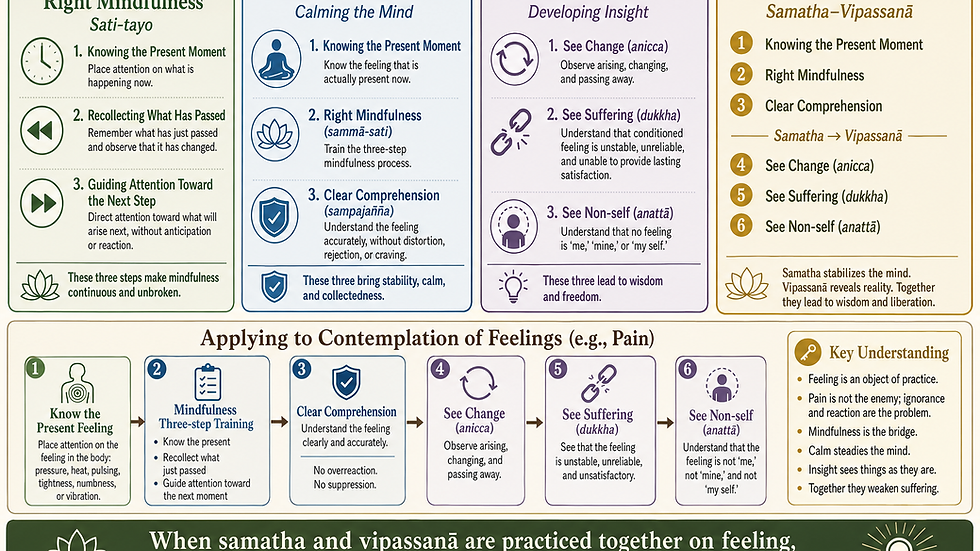
The samatha side of the practice steadies and calms the mind. When applied to contemplation of feelings, it can be trained through three steps:
Knowing the present moment;
Right mindfulness;
Clear comprehension.
Here, the first step should not be understood as samādhi in the full technical sense of meditative concentration. It is the initial training of placing attention on what is happening now. In this article, that means placing attention on the present feeling.
The practitioner first learns to be present with the feeling. Then right mindfulness is trained. Finally, clear comprehension is cultivated.
These three steps allow the practitioner to stay with feelings without being overwhelmed by them.
3. Step One of Samatha: Knowing the Present Moment
The first step is knowing the present moment.
In the contemplation of feelings, this means knowing the feeling that is actually present now. If pain is present in the knee, the practitioner places attention on the knee. If pressure is present in the soles of the feet during standing meditation, attention is placed there. If tightness is present in the shoulder or waist, attention is placed on that area.
The point is not to think about the pain. The point is to know the sensation directly.
At this stage, the practitioner may notice that what was called “pain” is actually made up of many smaller sensations:
pressure;
pulsing;
vibration;
burning;
heat;
tightness;
numbness;
itching;
movement;
wave-like change.
This first step is a training in present-moment knowing. The mind is brought to the feeling as it is happening now.
It is not yet necessary to analyze the feeling deeply. It is also not necessary to force the mind into a special state. The practitioner simply learns to stay with the present feeling clearly enough that the mind does not immediately run into aversion, fear, or storytelling.
In this way, knowing the present moment gives the practice a stable base.
4. Step Two of Samatha: Right Mindfulness as a Three-Step Training
The second samatha step is right mindfulness, sammā-sati.
In this method, right mindfulness is trained in three progressive steps. These are not three unrelated functions. They are practiced one after another.
First, the practitioner trains the first step. Then the second step is added to the first. Finally, the third step is added to the first two.
The three steps are:
Knowing the present moment;
Recollecting what has just passed;
Guiding attention toward the next step.
This is how mindfulness becomes continuous.
Step One: Knowing the Present Moment
The first step of right mindfulness is to know the present moment clearly.
In contemplation of feelings, this means knowing the present feeling. If the feeling is painful, the practitioner does not stop at the general label “pain.” Instead, the actual present sensation is observed.
Is it pressure?
Is it heat?
Is it vibration?
Is it burning?
Is it pulsing?
Is it numbness?
Is it tightness?
Is it movement?
The practitioner stays with the feeling as it is now.
This first step is acceptance. The feeling is allowed to be known. It is not immediately rejected, pushed away, or covered with mental commentary.
This does not mean liking the pain. It means knowing it directly.
Step Two: Adding Recollection of What Has Just Passed
Once the present feeling can be known, the second step is added.
The practitioner recollects what has just passed. The sensation that was present a moment ago is no longer exactly the same. It may have changed in strength, texture, location, temperature, or movement.
Even when pain seems continuous, close observation shows that it is changing.
One pulse appears and disappears.
One wave of pressure appears and disappears.
One burning sensation appears and disappears.
One moment of numbness appears and disappears.
This immediate recollection is not ordinary memory or fantasy. It is mindfulness noticing what has just happened.
Through this, the practitioner begins to see arising and passing away, udaya-vaya.
The feeling that has passed has not gone anywhere. The new feeling that arises has not come from anywhere. It simply appears and disappears according to conditions.
Step Three: Adding Guidance Toward the Next Step
When the first two steps are stable, the third step is added.
Mindfulness now guides attention toward the next step. This does not mean imagining the future. It means that the mind is ready to meet the next sensation with balance.
Another pulse may arise.
Another wave of heat may arise.
Another movement of pressure may arise.
Another sensation may appear in a different place.
The practitioner receives the next feeling without rejection, craving, or habitual reaction.
This third step is very important. It prevents the mind from falling back into automatic resistance.
The training becomes:
Know the present moment;
Recollect what has just passed;
Meet the next step with balance.
This is right mindfulness applied to feeling.
5. Step Three of Samatha: Clear Comprehension
The third samatha step is clear comprehension, sampajañña.
Clear comprehension means knowing the feeling accurately and appropriately. The practitioner knows what is actually happening and does not distort it through desire or aversion.
If the feeling is heat, it is known as heat.
If it is pressure, it is known as pressure.
If it is vibration, it is known as vibration.
If it is numbness, it is known as numbness.
If it is changing, it is known as changing.
The practitioner does not reject the present feeling and search for a better one. One does not think, “This feeling should not be here,” or “I must get rid of this before I can practice.”
Clear comprehension follows the feeling as it is.
It also understands what is suitable. If the body is in danger or the posture must be adjusted, this can be known clearly. But if the main issue is ordinary meditation discomfort, the practitioner continues to observe without immediately reacting.
Clear comprehension protects the practice from both extremes: forcing and escaping.
6. Seeing Through the Concept of Pain
Pain is often experienced through concepts. The mind quickly says:
“This is pain.”
“This is my pain.”
“My knee hurts.”
“I cannot continue.”
“This is too much.”
These concepts are powerful. Once the concept becomes fixed, the mind suffers more.
In this method, the practitioner learns to see through the concept without denying the experience.
“Pain” is a concept.
“Feeling” is also a concept.
“My body” is a concept.
“I am suffering” is a concept.
But when the actual experience is observed closely, it is not one solid thing. It is a changing process of sensations.
There is heat.
There is pressure.
There is vibration.
There is pulsing.
There is movement.
There is arising.
There is ceasing.
By observing in this way, the concept of pain begins to break apart. The practitioner is no longer trapped by the idea of pain as one solid, unbearable thing. This is why unpleasant feeling can become a condition for liberation.
7. The Vipassanā Side in Contemplation of Feelings
After the mind has become steadier through knowing the present moment, right mindfulness, and clear comprehension, the same feeling is used for insight.
The vipassanā side of the practice includes three steps:
Contemplation of impermanence;
Contemplation of suffering;
Contemplation of not-self.
These are known in Pāli as:
anicca — impermanence;
dukkha — suffering, unsatisfactoriness, or unreliability;
anattā — not-self.
These are not merely ideas to believe. They are to be seen directly in the experience of feeling.
8. Vipassanā Step One: Seeing Impermanence
The first insight step is contemplation of impermanence, anicca.
The practitioner observes that feeling does not remain the same.
A painful sensation arises and passes away.
A pulse arises and passes away.
A burning sensation arises and passes away.
A wave of pressure arises and passes away.
A moment of numbness arises and passes away.
Even if discomfort continues, the exact feeling is changing moment by moment. This is seen directly through the second step of mindfulness: recollecting what has just passed. The previous sensation has disappeared. The present sensation is new. The next sensation will also arise and pass.
In this way, the practitioner sees that feeling is not stable. It is not fixed. It cannot be held.
This is insight into impermanence.
9. Vipassanā Step Two: Seeing Suffering
The second insight step is contemplation of suffering, dukkha.
Here, suffering does not only mean obvious pain. It also means that conditioned experience is unstable, unreliable, and unable to provide lasting satisfaction.
Unpleasant feeling shows this clearly. When pain appears, the mind wants it to stop. When discomfort continues, the mind becomes restless. When the body changes, the mind sees that it cannot fully control experience.
Even pleasant feelings are unstable. They arise and pass away. Neutral feelings also arise and pass away.
So the practitioner understands:
Whatever is impermanent is unreliable.
Whatever is unreliable cannot be a secure refuge.
Whatever cannot be held cannot give lasting satisfaction.
This is why impermanence is seen as suffering.
The purpose is not to become pessimistic. The purpose is to see clearly. When the practitioner sees that feeling cannot provide final safety, attachment begins to weaken.
10. Vipassanā Step Three: Seeing Not-Self
The third insight step is contemplation of not-self, anattā.
Feeling is usually taken personally. The mind says:
“I feel pain.”
“I am suffering.”
“This is happening to me.”
“My body is hurting.”
But when feeling is observed carefully, no permanent “I” can be found inside it.
There is sensation.
There is knowing.
There is reaction.
There is habit.
There is change.
But the feeling itself is not “I.”
The painful area is not “I.”
The reaction is not “I.”
The body is not a permanent self.
The experience is not owned by a fixed self.
The practitioner observes:
This feeling is not me.
This feeling is not mine.
This feeling is not myself.
In Pāli, this contemplation is expressed as:
Netaṃ mama, nesohamasmi, na meso attā.
“This is not mine, this I am not, this is not my self.”
Through contemplation of feeling, the practitioner begins to understand not-self directly.
11. From Harmful Cycle to Liberation
Before this method is understood, unpleasant feelings often create a harmful cycle.
Pain appears.
The mind resists.
Aversion arises.
The body tightens.
The mind becomes frustrated.
The pain feels stronger.
More resistance appears.
This is a cycle of suffering.
With practice, the same painful feeling is approached differently.
Pain appears.
The practitioner knows the present moment.
The present sensation is known.
What has just passed is recollected.
The next sensation is received with balance.
The feeling is known with clear comprehension.
Impermanence is seen.
Suffering is understood.
Not-self is contemplated.
In this way, feeling becomes a path of practice.
The practitioner may still feel unpleasant sensations, but the mind is less bound by them. Pain no longer automatically produces mental suffering.
This is the beginning of freedom within feeling.
12. Daily-Life Application
Contemplation of feelings is not limited to formal meditation.
In daily life, feelings arise constantly: bodily comfort, discomfort, tiredness, warmth, cold, hunger, pressure, ease, irritation, pleasure, and neutrality.
The same training can be applied.
First, know the present moment.
Then recollect what has just passed.
Then meet the next step with balance.
For example, when standing in line, discomfort may appear in the legs. Instead of immediately becoming irritated, one can know the pressure, tightness, or tiredness as feeling.
When working at a desk, tension may appear in the shoulders. One can know the present sensation, notice its change, and respond wisely.
When washing dishes, walking, cooking, or cleaning, pleasant and unpleasant feelings arise. They can all become objects of practice.
The goal is not to watch feelings in a stiff or artificial way. The goal is to bring mindfulness and clear comprehension into ordinary experience.
13. A Practical Sequence for Contemplation of Feelings
The practice can be summarized in six steps.
The Samatha Side
First, know the present moment.
Place attention on the area where the feeling is clear. Stay with the sensation without immediately reacting. This is not yet samādhi in the full technical sense. It is the basic training of being present with the feeling.
Second, apply right mindfulness.
Train the three steps:
Know the present moment;
Recollect what has just passed;
Guide attention toward the next step.
Third, apply clear comprehension.
Know the feeling as it truly is. Do not exaggerate it, deny it, reject it, or cling to it.
Understand what is suitable and continue with balance.
The Vipassanā Side
Fourth, contemplate impermanence.
See that feeling arises and passes away moment by moment.
Fifth, contemplate suffering.
See that feeling is unstable, unreliable, and unable to provide lasting satisfaction.
Sixth, contemplate not-self.
See that feeling is not “I,” not “mine,” and not “myself.”
This is samatha-vipassanā applied to contemplation of feelings.
14. Important Attitudes in the Practice
Several attitudes are important when practicing with feelings.
Do not run away from the feeling too quickly.
Do not suppress the feeling.
Do not become angry at the feeling.
Do not turn the feeling into a personal story.
Do not force the body beyond what is reasonable.
Do not crave a different experience.
Do not reject the present experience.
Instead, know the feeling directly.
Receive it.
Observe it.
Understand it.
Let insight develop from it.
This is a balanced way to practice.
Conclusion
Contemplation of feelings, vedanānupassanā, is a direct and powerful field for applying samatha-vipassanā.
The samatha side begins with knowing the present moment, then trains right mindfulness and clear comprehension. The vipassanā side investigates feeling through impermanence, suffering, and not-self.
Right mindfulness is trained progressively. First, the practitioner knows the present moment. Then recollection of what has just passed is added. Finally, mindfulness guides attention toward the next step.
Through this training, painful feelings are no longer only obstacles. They become meditation objects. They become places where the practitioner can see arising and passing away, understand the unreliable nature of conditioned experience, and weaken the habit of identifying with feeling as “I” or “mine.”
In this way, unpleasant feelings can become conditions for freedom.


Comments