A Storm, a Cowherd, and the Question of What Makes Us Safe
In a recent conversation with Bhante Sujato, an ancient poem became a vivid encounter with the hopes, fears and everyday attachments that shape our lives.

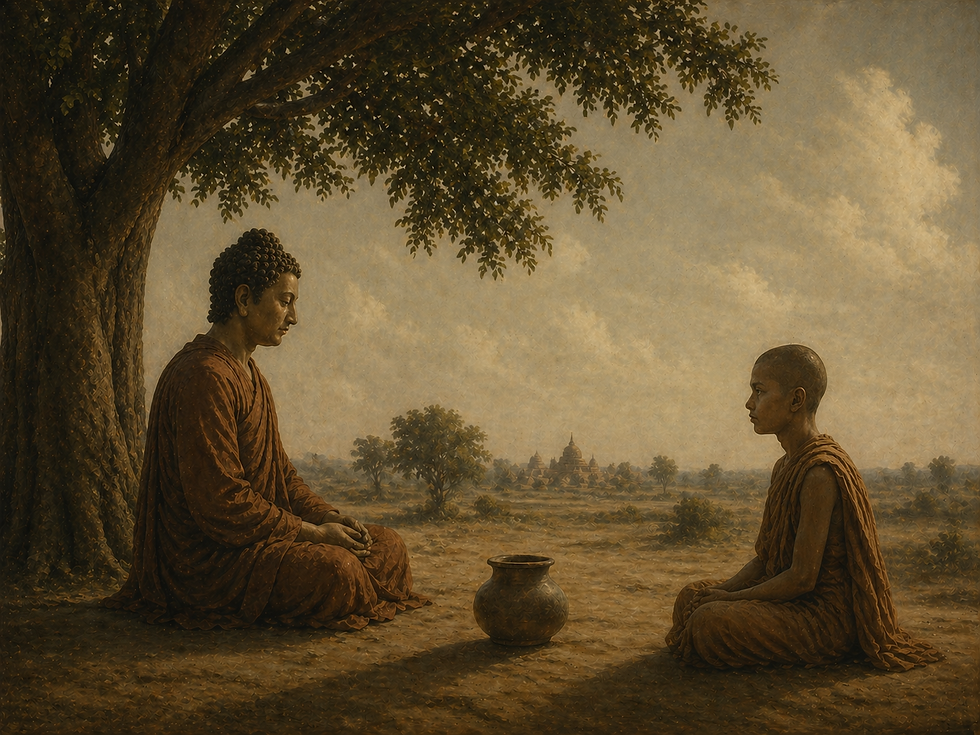
A man stands beside a river as the rain threatens. His rice is cooked, his milk is ready, his family and animals are close by. His home is secure—or so he believes. He has tended his household fire and trusts that everything is in order.
“Rain, if you wish,” he tells the sky.
This is the opening mood of the Dhaniya Sutta, a short poem in the Sutta Nipāta. At Agama Meditation Centre’s recent conversation with Bhante Sujato, the story became more than an old exchange of verses. Bhante first helped us imagine the world Dhaniya lived in—and then invited us to listen closely to how the Buddha responded.
Before asking what it means to us
Bhante Sujato described a thoughtful way of approaching a sutta: before asking what it means for us today, ask what it might have meant to the people who first heard it.
What was their world like? What did they depend on? What were they worried about? And how did the Buddha meet them in that world?
In the Dhaniya Sutta, the setting matters. Bhante explained that rivers and monsoon rains could make life on the plains uncertain. Dhaniya’s confidence in his home, family, cattle and ritual practices was not abstract. These were the things that made life feel secure.
With that context in view, the Buddha’s replies take on a different texture. He does not simply dismiss Dhaniya’s confidence. Instead, he answers in the same lively, almost playful style, turning Dhaniya’s claims around. Dhaniya speaks of a fire that has been kindled; the Buddha speaks of his fire being quenched. Dhaniya trusts in what he has gathered and protected; the Buddha points toward a freedom that does not depend on possessions or favourable conditions.
The dialogue is memorable partly because the Buddha is not delivering a lecture from outside Dhaniya’s life. He responds to the words Dhaniya uses and the security he values.
When the rain actually comes
Then the rain arrives.
Dhaniya’s confidence meets a reality he cannot control. Bhante drew attention to the force of this moment: Dhaniya has performed his rituals and feels prepared, yet the weather still comes on its own terms. In the story, that experience becomes a turning point. Dhaniya and his wife turn toward the Buddha and ask to follow the path.
The point is not that the sutta tells us to abandon our homes, families or responsibilities. Rather, it asks us to look carefully at what we rely on—and whether we mistake the things we cherish for things we can keep safe forever.
Our own versions of Dhaniya’s shelter may look different: a steady income, a carefully made plan, good health, a comfortable home, or the feeling that we have done everything we can to prevent uncertainty. These things matter. But they are also vulnerable to change.
Seeing that clearly need not make us gloomy. It can help us hold what we love with more balance, and notice where fear or attachment has quietly taken hold.
Context makes the teaching feel closer
Bhante’s approach showed how historical context can bring a text closer rather than make it feel remote. When we learn something about the people, customs and pressures surrounding a sutta, we can hear the conversation with greater sensitivity. We begin to see not only what the Buddha taught, but how he met people where they were.
This is also part of why early Buddhist texts are explored through more than one collection. The Pāli discourses and the Chinese Āgamas preserve many teachings that can be studied alongside one another. Comparing parallel texts can help readers notice shared teachings and differences in how they were transmitted. Not every discourse has a direct parallel, though; the Dhaniya Sutta, for example, is part of a collection preserved in the Pāli canon.
For newcomers, this kind of study may sound academic. But the conversation brought it back to a very human question: when life feels uncertain, what do we reach for—and what might help us meet that uncertainty with a freer mind?
That is the spirit of From Ancient Texts to Living Practice: reading each sutta in its own setting, listening to the people and questions within it, and discovering how its teaching can speak to our lives now.
Come join us in our next live session with Bhante Sujato!


Comments