The Child Who Chanted the Suttas
A story of rebirth, memory, and the ancient science of recitation
In Sri Lanka, in the late 1960s, a little boy named Dhammaruwan began doing something no one around him could explain.
He was only about two years old.
Sometimes, he would sit quietly, almost as if in meditation. Then he would begin to chant.
The sounds were not ordinary baby speech. They were not nursery rhymes. They were not words his mother understood. At first, she tried to stop him, thinking it was meaningless babbling.
But later, others recognized something astonishing.
The child was chanting in Pāli, the ancient language in which many early Buddhist discourses have been preserved.
Even more striking, part of what he chanted was identified as the Dhammacakkappavattana Sutta—the Buddha’s first teaching after his awakening, the discourse on the Four Noble Truths.
How could a child so young chant a text he had never learned?
This remarkable case was later discussed by Bhikkhu Anālayo in Rebirth in Early Buddhism and Current Research. Anālayo does not present the story merely as a miracle. He studies it carefully, alongside early Buddhist teachings on rebirth, modern research on memory, and cases in which children appear to recall knowledge from a previous life.[1]
For Buddhist practitioners, the story naturally raises a powerful question:
Can the Dharma be carried from one life to another?
The boy’s memory of another life
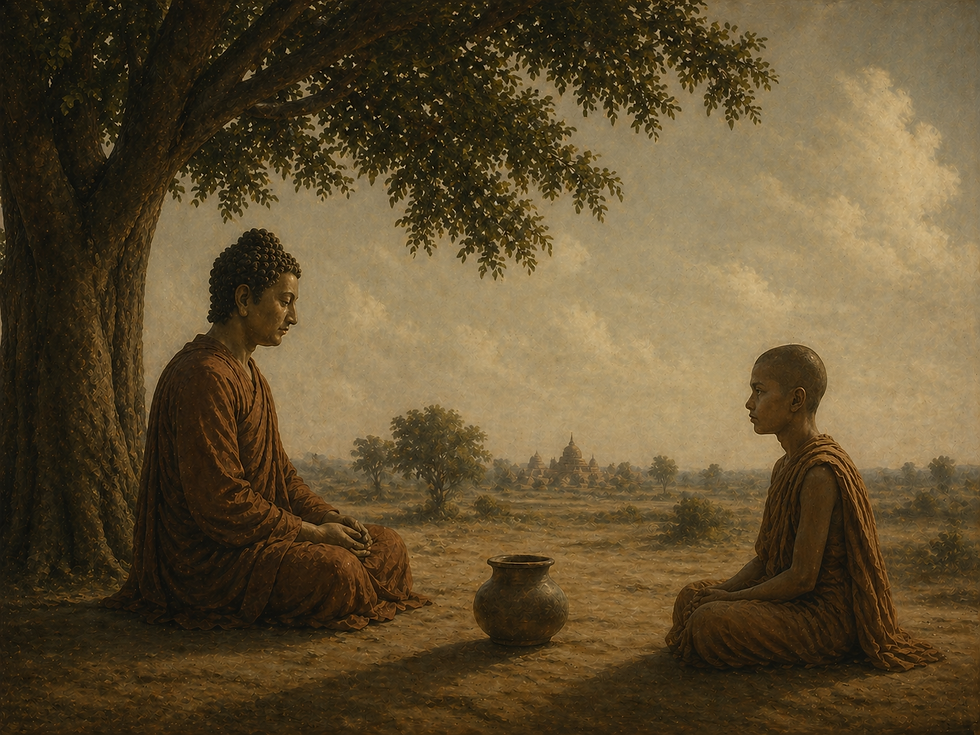
According to Dhammaruwan’s own memories, the chants came from a previous life.
He recalled that he had once been born in India as the son of a Brahmin.
For many modern readers, this word may be unfamiliar. In ancient India, Brahmins were the priestly and learned class. They were traditionally responsible for preserving the Vedas, the ancient sacred texts of Brahmanical religion. From a young age, Brahmin boys could be trained to memorize long passages of sacred language with great precision—often through repeated recitation, rhythm, and exact pronunciation.
This detail is important.
Dhammaruwan did not remember merely being a child who liked chanting. He remembered being born into a culture where sacred sound, memorization, and oral transmission were taken very seriously.
Later, according to the story, he became a Buddhist monk. He remembered studying under the great scholar-monk Buddhaghosa—known in Chinese as 觉音 or 佛音, and famous as the author of the Visuddhimagga, The Path of Purification. He also remembered being trained as a bhāṇaka, a professional reciter responsible for preserving Buddhist texts by memory.[2]
In other words, Dhammaruwan’s remembered past life was not random. It was a life centered on recitation.
A Brahmin childhood trained in sacred memorization.A conversion to Buddhism.Training as a monk-reciter.A journey connected with Buddhaghosa and Sri Lanka.Then, centuries later, a Sri Lankan child begins chanting Pāli suttas.
Whether one approaches this story with faith, curiosity, or caution, the pattern is striking. It points us toward one of the most important but often forgotten facts about early Buddhism:
Before the Dharma was written in books, it was carried by living voices.

The ancient science of recitation
At first, it may seem strange that ancient traditions trained children to recite sacred texts before they fully understood them.
Modern people often assume that understanding must come first.
But if the goal is to preserve a text exactly, the ancient method has a deep logic.
A child who does not yet understand a difficult teaching is less likely to reshape it.
He is not trying to explain it, improve it, or make it fit his own ideas. He simply learns the sound.
This is not anti-intellectual. It is a memory technique.
Bhikkhu Anālayo has drawn attention to a revealing study on textual memory.
Participants were asked to memorize technical instructions for Microsoft Word.
They were divided into groups according to their familiarity with the software: experienced users, people with some knowledge, and complete beginners.
The surprising result was that the beginners remembered the wording most accurately. Since they did not understand the technical meaning, they were less tempted to paraphrase. They remembered the words more as words.
Anālayo compares this to ancient recitation traditions. In Vedic training, young students memorized sacred texts before they were taught their full meaning. This helped preserve the wording with extraordinary precision over many generations.
The same principle helps us understand Buddhist recitation. The sound-pattern is preserved first. Understanding comes later.
Modern memory research supports this broader point. Memory is not like a recording device. It is often reconstructed through what we already know, expect, and believe. Psychologist Frederic Bartlett famously argued that remembering is not simple reproduction, but reconstruction. Later research on sentence memory and “gist” memory also shows that people often remember the meaning of a statement more easily than its exact wording.[3]
In other words, understanding helps us remember—but it can also change what we remember.
This is why recitation is powerful.
When a text is chanted again and again, the body learns the sequence. The mouth remembers the rhythm. The ear notices when something is missing. In communal chanting, the group also protects the individual from drifting too far.
The chant becomes a living archive.
Recent cognitive research on children and recitation also supports the value of active vocal repetition. One study found that repeated recitation helped kindergarten children retain complex verbal material over the long term, including both exact wording and general meaning.[4]
So the ancient tradition was not primitive.
It understood something subtle: If you want to preserve the exact words, first train the voice. Then train the understanding.
Why this matters for the suttas
Before Buddhist teachings were books, they were recited.
The Buddha’s words were heard, memorized, repeated, and passed from teacher to student. The early Buddhist community developed a powerful oral culture: repeated phrases, numbered lists, standard openings, rhythmic formulas, and communal chanting.
These were not accidents. They were tools.
They helped preserve the teachings for centuries before they were written down.
Bhikkhu Anālayo has written about this in his research on early Buddhist oral transmission. He notes that the differences and similarities among Pāli, Sanskrit, Chinese, and Tibetan versions of early Buddhist texts can be understood through two forces working together: the natural vulnerability of human memory, and the strong communal effort to transmit teachings accurately.[5]
This gives Dhammaruwan’s story a wider significance.
His childhood chanting does not “prove” that every word of every sutta has been preserved unchanged. That would be too strong a claim.
But it does show something important:
The Buddhist oral tradition had the power to preserve complex Pāli texts with remarkable force.
A child chanting the Dhammacakkappavattana Sutta becomes a vivid reminder that the Dharma was not first preserved in libraries. It was preserved in living bodies—in breath, voice, memory, and devotion.
The first turning of the Dharma wheel

The sutta Dhammaruwan chanted was not an obscure text.
The Dhammacakkappavattana Sutta, “The Discourse on Turning the Wheel of Dharma,” is remembered as the Buddha’s first teaching after awakening. In it, the Buddha teaches the Middle Way and the Four Noble Truths: suffering, its arising, its cessation, and the path leading to its cessation.
That is what makes Dhammaruwan’s chanting so striking. The words that came from this young child were connected with the very beginning of the Buddha’s teaching career.
The importance of this discourse is supported not only by faith, but also by textual history. The Dhammacakkappavattana Sutta is preserved in the Pāli canon at Saṃyutta Nikāya 56.11. A close parallel is also found in the Chinese Saṃyukta Āgama, where Anālayo identifies SĀ 379 as the Chinese counterpart to SN 56.11.[6] Related versions also appear in other Buddhist traditions, including Vinaya materials and Sanskrit or Tibetan witnesses.[7]
This matters because these traditions were transmitted by different Buddhist communities. When separate lineages preserve the same core teaching—the Middle Way, the Four Noble Truths, the Deer Park at Vārāṇasī, and Koṇḍañña’s awakening—it gives us reason for thoughtful confidence that this discourse belongs to a very early layer of Buddhist tradition.
Dhammaruwan’s story gives us a living image of oral memory. The Chinese Āgama parallel gives us textual evidence across traditions. Together, they suggest that the early teachings were not preserved casually. They were carried with care.
Historical echoes in Dhammaruwan’s memory
Dhammaruwan’s memories cannot be fully verified, but several details fit known Buddhist history—and that gives the story added weight.
First, Buddhaghosa was a real and influential 5th-century Buddhist scholar-monk. He is traditionally known as Bhadantācariya Buddhaghosa, and his great work, the Visuddhimagga (The Path of Purification), became one of the most important summaries of Theravāda Buddhist doctrine and meditation.[8]
Second, Buddhaghosa is historically connected with Sri Lanka. Traditional accounts say he traveled there to study the old Sinhala commentaries and render them into Pāli or Magadhan. The Path of Purification tradition places him at
Anurādhapura, one of the great centers of ancient Sri Lankan Buddhism.[9]
Third, Dhammaruwan’s remembered role as a trained reciter also fits the world of early Buddhism. Buddhist teachings were preserved for centuries through memorization, chanting, and communal recitation before they were written down.
Finally, the text he chanted—the Dhammacakkappavattana Sutta—is itself widely attested. It appears in the Pāli canon and has a close parallel in the Chinese Saṃyukta Āgama, along with related versions in other Buddhist traditions.
None of this proves that Dhammaruwan was a monk who traveled with Buddhaghosa in a previous life. But the historical background does not contradict his memory. On the contrary, several key elements—Buddhaghosa, Sri Lanka, trained reciters, and the ancient sutta tradition—belong to the same historical world.
That is what makes the story so intriguing.
It stands at the meeting point of personal memory, Buddhist history, and the living tradition of recitation.
What we repeat, we become
It would be easy to tell Dhammaruwan’s story as something sensational: a child remembers a past life, chants ancient scripture, and speaks words no one taught him.
But the deeper meaning is quieter.
The story asks us to consider how deeply the Dharma can be planted in the mind.
In early Buddhism, rebirth belongs to a larger vision of cause and effect. Intentions matter. Actions leave traces. Repeated habits shape consciousness.
What we repeat becomes familiar. What becomes familiar becomes natural. And what becomes natural may continue in ways we do not fully understand.
If Dhammaruwan’s memory is true, then the Dharma he recited in one life continued to echo in another. But even if we approach the story cautiously, it still speaks directly to our own practice.
We are all reciters.
Every day, we repeat something: worries, desires, fears, old stories about who we are. Buddhist practice invites a different repetition. We return to the breath, to kindness, to awareness, to the teachings, and to the possibility of freedom.
This is why chanting, meditation, and study matter. They are ways of shaping memory at the deepest level.
The Buddha’s teaching was first carried by living voices. Today, when we recite, listen, and practice, we join that same stream.
The Dharma is not only something we read.
It is something we remember. Something we embody. Something we become.
Bojjhaṅga (Gilāna) Suttas — Pāli: SN 46.14–16; no clear Chinese Āgama parallel identified.
Dhammacakkappavattana Sutta — Pāli: SN 56.11; Chinese parallel: 《雜阿含經》379 / SĀ 379, “轉法輪經.”
Girimānanda Sutta — Pāli: AN 10.60; no direct Chinese Āgama parallel identified.
Maṅgala Sutta — Pāli: Snp 2.4 / Khp 5; Chinese parallel outside the Āgamas: 《法句譬喻經》T 211, 吉祥品第三十九. Ratana Sutta — Pāli: Snp 2.1 / Khp 6; Metta Sutta — Pāli: Snp 1.8 / Khp 9; no Chinese Āgama parallel identified.
Endnotes
[1] Wisdom Publications’ summary of Anālayo’s account states that Dhammaruwan was born in Sri Lanka and, at a very young age, spontaneously chanted ancient and complex Pāli suttas. (The Wisdom Experience)
[2] According to the Wisdom Publications article on Dhammaruwan’s story, Dhammaruwan remembered a previous life in India as the son of a Brahmin, trained in Vedic memorization, later ordained as a Buddhist monk, trained as a bhāṇaka, and chosen to accompany Buddhaghosa from India to Sri Lanka. (The Wisdom Experience)
[3] Anālayo’s “The Vicissitudes of Memory and Early Buddhist Oral Transmission” applies modern memory research, including the reconstructive nature of memory, to early Buddhist oral transmission. (tidipa.github.io) Loftus’s review defines the misinformation effect as impairment in memory after exposure to misleading information and surveys decades of research on the malleability of memory. (learnmem.cshlp.org)
[4] Eghbaria-Ghanamah et al. studied repeated listening and active recitation in kindergarten children and long-term retention of complex texts. (PubMed)
[5] Anālayo frames the similarities and variations among Pāli, Sanskrit, Chinese, and Tibetan versions as partly reflecting the interaction between the natural limitations of memory and the attempt at accurate oral transmission. (tidipa.github.io)
[6] Anālayo’s Saṃyukta-āgama Studies lists SĀ 379 as the Saṃyukta Āgama parallel to SN 56.11, the Dhammacakkappavattana Sutta.
[7] In his study of the Dhammacakkappavattana Sutta, Anālayo discusses the discourse and its parallels across Buddhist textual traditions; his Ekottarika-āgama Studies also notes how oral transmission tends to stereotype material in ways that facilitate memorization.
[8] Bhikkhu Ñāṇamoli’s introduction to The Path of Purification describes the Visuddhimagga as a systematic summary and interpretation of the Buddha’s teaching in the Pāli Tipiṭaka, and identifies it as a principal non-canonical authority in Theravāda.
[9] The Path of Purification introduction preserves traditional accounts of Buddhaghosa’s journey to Sri Lanka and his work of translating or rendering the Buddha’s Dispensation and commentaries into Magadhan/Pāli. It also notes that Buddhaghosa came to Anurādhapura and studied the Sinhala commentaries there.


Comments